
Commercial photography is one of the most exciting and profitable branches of the photography world.
In this field, art, creativity, and marketing come together to help brands showcase their products and services through impactful and persuasive images.
If you’ve always dreamed of turning your passion for photography into a real career, this guide will walk you step by step through the process of becoming a professional commercial photographer.
What Is Commercial Photography?
Commercial photography is the art and business of creating images that help promote, sell, or represent products, services, and brands.
It’s widely used in advertising, marketing, and corporate communications — and covers a range of categories such as:
- Product and advertising photography
- Architectural and industrial photography
- Fashion and lifestyle campaigns (Modelling and Fashion Photography)
- Corporate headshots and portraits
- Beverage and food photography
In short, a commercial photographer captures visuals that drive business results.
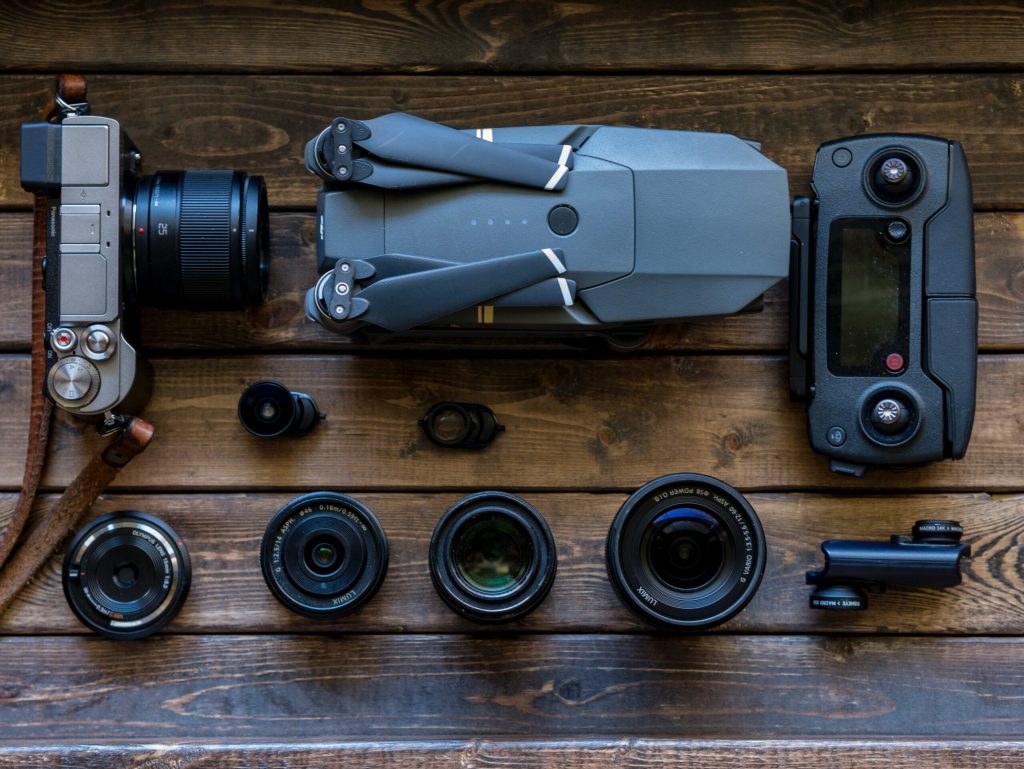
What is a commercial image?
A commercial image is a photo made specifically to sell, promote, or brand a product, service, or company. Its sole purpose is persuasion—not personal expression or art. You see it in ads, catalogs, social media, billboards, and packaging. Its success is measured by business results (sales, clicks, brand awareness), not by beauty or creativity alone. It’s always client-commissioned, follows a strict brief, and is legally licensed for commercial use. In short: if the image is made to make money, it’s a commercial image.
How to get into commercial photography
To get into commercial photography or how to become a commercial photographer, start by learning the fundamentals of photography and understanding how images are used for marketing and branding. Build a strong, focused portfolio that reflects the type of commercial work you want to attract, such as product, industrial, lifestyle, or corporate photography. Invest in professional equipment, practice working with lighting, and learn basic business skills like pricing, contracts, and client communication. Networking with businesses, agencies, and creative professionals, along with consistent personal projects and online presence, will help you gain visibility and gradually enter the commercial photography market.
Professional Vancouver photographer capturing your most meaningful moments with artistic precision and natural light. Book your session today and turn your memories into timeless visual stories.
The Role of a Commercial Photographer
A successful commercial photographer is both an artist and a strategist.
They understand composition, lighting, branding, and psychology — blending creativity with purpose.
Every shot must tell a story that connects emotionally and commercially with the audience.Read How to Choose the Right Industrial Photographer for Your Company
Steps to Becoming a Professional Commercial Photographer
Build a Strong Technical Foundation
Before entering the professional market, invest time in mastering the technical side of photography. Learn:
- Lighting setups (studio and natural)
- Exposure, ISO, and shutter control
- Composition and visual storytelling
- Editing and color grading in Lightroom or Capture One
Formal education isn’t mandatory, but workshops and online courses can give you structure and industry insight.Read Technical Challenges of Lighting and Equipment in Industrial Environments
Invest in the Right Equipment
Quality gear helps you deliver professional results. Start with essentials and upgrade as you grow.
Recommended gear:
- Full-frame DSLR or mirrorless camera
- Prime and zoom lenses
- Studio lighting and modifiers
- Reflectors and tripods
- Editing software (Adobe Lightroom, Photoshop, Capture One)
If you plan to focus on industrial photography in Canada, durability and weather-resistant equipment are crucial for outdoor or factory environments.
Choose Your Niche
The commercial photography industry is vast. Specializing helps you attract the right clients and refine your creative voice.
Popular niches:
- Product photography for e-commerce
- Corporate and industrial photography
- Real estate and architecture
- Lifestyle and advertising campaigns
- Food and beverage photography for restaurants and brands
Find what excites you most — and where your skill set adds value.

Build a Professional Portfolio
Your portfolio is your best sales tool. Start with personal projects or collaborations to show what you can do. Focus on consistency, style, and story.
Include case studies showing before-and-after editing, lighting setup, and the marketing purpose behind each photo.
For professionals like Mandana Rostami, a strong portfolio became the foundation for building long-term client relationships in Vancouver’s competitive creative market.
Learn Business and Marketing Skills
A commercial photographer runs a business — not just a studio. Learn to:
- Create contracts and pricing packages
- Negotiate licensing and usage rights
- Communicate with clients effectively
- Develop your personal brand
Take time to understand SEO, email marketing, and social media strategy — these are key to generating steady projects and referrals.
You can see Wedding Photographer in Vancouver
Build a Network and Collaborate
Networking is one of the fastest ways to grow in commercial photography.
Attend creative events, exhibitions, and workshops to meet like-minded professionals.
Mandana Rostami, a Vancouver-based commercial and industrial photographer, has demonstrated the power of collaboration in her career.
Through consistent professionalism and teamwork, she has worked with agencies, production groups, corporations, and individual clients — building valuable experience and credibility in the process.
Strong collaborations not only bring new clients but also expand your artistic perspective and business network.(Professional photography)
Create a Professional Online Presence
In a city as creative and competitive as Vancouver, Canada, a strong online presence is essential.
Here’s how to stand out:
- Build a professional website: Include your portfolio, biography, testimonials, and a contact form for inquiries.
- Start a blog: Share your behind-the-scenes stories, photography techniques, and recent projects to boost SEO.
- Optimize for keywords: Use local SEO terms like Vancouver commercial photographer and industrial photographer in Canada to attract nearby clients.
- Be active on social media: Platforms like Instagram, LinkedIn, and Pinterest are essential for creative visibility. Post consistently, use hashtags, and engage with followers.
Don’t forget to list your business on Google Maps, Yelp, and Creative Canada directories to enhance your local search ranking.
Understand Copyright and Licensing
Commercial photography involves image rights and legal contracts.
Always define:
- Who owns the final images
- How and where they can be used (print, digital, advertising, etc.)
- The duration of usage rights
Having a clear contract protects both your work and your income.
Pricing and Value
Setting your rates can be challenging. Research local market prices in Vancouver and consider:
- Day rate vs. project-based pricing
- Licensing fees per image
- Post-production time and expenses
Remember: your value lies in your creativity, reliability, and ability to help brands communicate effectively.
Also you can see Pet and Family Photography
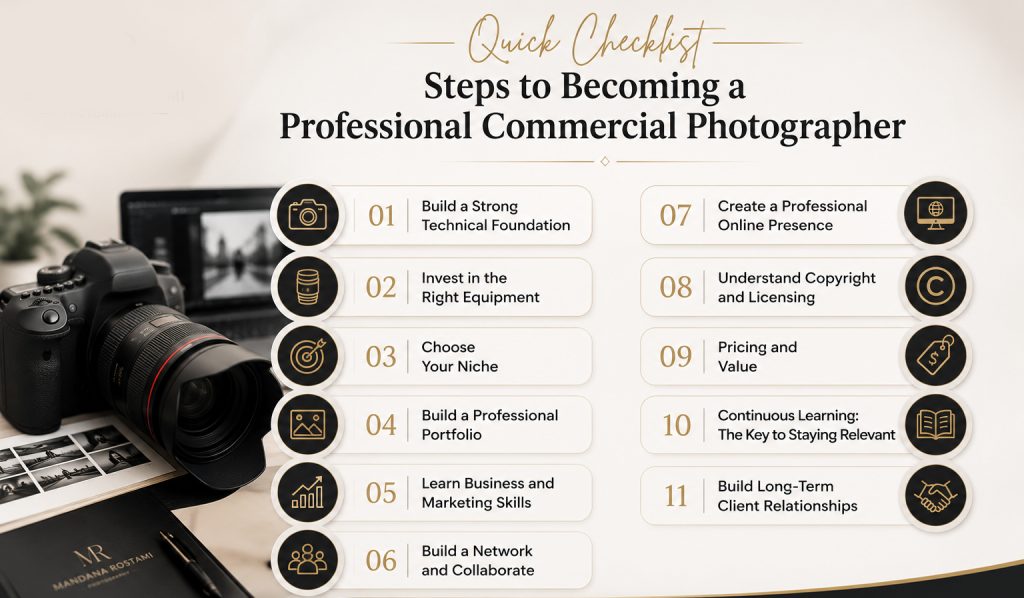
Continuous Learning: The Key to Staying Relevant
The commercial photography industry evolves rapidly — and true professionals never stop learning.
Here’s how to stay ahead of the curve:
- Embrace new technology: Follow updates from Canon, Sony, and Nikon to stay familiar with the latest autofocus systems, sensors, and AI tools.
- Master professional software: Explore advanced tools like Capture One, DaVinci Resolve, and Topaz Labs to refine your editing workflow.
- Attend workshops and conferences: In Vancouver, there are regular events for lighting, storytelling, and brand photography. These offer not just learning, but excellent networking opportunities.
- Study global trends: Analyze successful ad campaigns from brands like Apple or Patagonia — understand how they use light, emotion, and minimalism to influence consumers.
- Improve soft skills: Communication, time management, and presentation are what turn photographers into trusted professionals.
Continuous learning keeps your creativity sharp and your business competitive — especially in fast-growing markets like Canada’s creative industry.
Build Long-Term Client Relationships
Delivering consistent quality is the best marketing strategy. Follow up after every project, ask for testimonials, and maintain contact with satisfied clients.
Personalized communication often leads to referrals — the most powerful form of organic growth.
Commercial photographer job description
A commercial photographer creates purpose-driven images to market products, services, or brands. Their daily responsibilities include:
- Collaborating with clients to understand project goals and brand guidelines
- Planning and organizing photoshoots, including locations, props, and models
- Operating cameras, lighting, and other professional equipment
- Directing models or product stylists to capture the desired mood and message
- Editing and retouching images using software like Photoshop or Lightroom
- Delivering final images on time and maintaining a strong portfolio
They often work with marketing teams and may specialize in fashion, food, product, or corporate photography.
How to become a commercial photographer
Becoming a commercial photographer involves more than just mastering the camera—it requires business and marketing skills too. Key steps include:
- Build a strong portfolio: Focus on a specific niche (e.g., product, food, fashion) and create work that attracts the clients you want.
- Learn the business side: Understand pricing, bidding, contracts, and licensing. Many photographers start by assisting experienced pros to learn the trade.
- Develop your network: Build relationships with art directors, marketing teams, and brands. Professionalism and clear communication are essential for repeat work.
- Master lighting and composition: Technical skill is a must—especially in controlling light, which is the foundation of commercial work.
- Stay adaptable: Be ready to shoot anywhere—from studios to industrial sites—and adjust to client needs quickly.
Starting as a photographer’s assistant is a common entry point to gain experience and connections.
Commercial Photographer salary
Commercial photographer income varies widely based on experience, location, and specialty. In the United States:
- Average annual salary: Around $62,000–$64,000.
- Entry-level (under 1 year): Approximately $37,000 per year.
- Experienced (mid-career): Around $51,000–$64,000.
- Top earners (90th percentile): Can make $74,000–$90,000 or more annually.
- Hourly rate: Roughly $30/hour on average.
Freelance photographers often have variable income and need to factor in business costs like equipment, insurance, and marketing.
Commercial photography examples
Commercial photography is everywhere in advertising and branding. Common examples include:
- Fashion campaigns: Ads for clothing brands featuring models in styled settings (e.g., Chanel, Ralph Lauren).
- Product photography: Clean, detailed shots of items like cosmetics, electronics, or beverages for e-commerce or catalogs.
- Food photography: Appetizing images of dishes for menus, packaging, or restaurant ads.
- Corporate portraits: Professional headshots and team photos for company websites and annual reports.
- Lifestyle photography: Showing products in real-life use—e.g., a person hiking in an outdoor brand’s jacket.
- Architectural and interior photography: Images of buildings, offices, or homes for real estate or design portfolios.
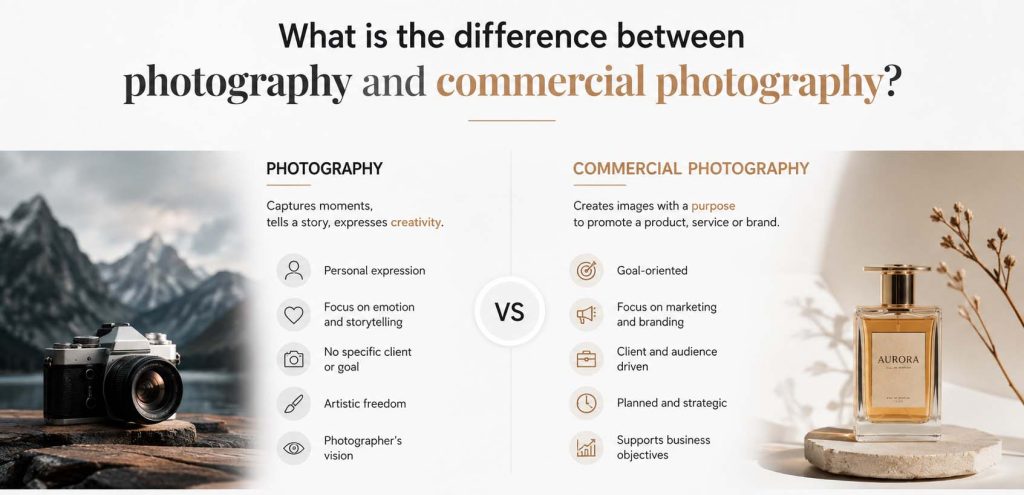
What is the difference between photography and commercial photography?
The main difference between general photography and commercial photography lies in their ultimate purpose; general photography—whether artistic, documentary, or personal—is primarily about expressing the photographer’s vision, emotion, or aesthetic, and its success depends on emotional impact, creativity, and originality, whereas commercial photography is entirely client-driven and created with a specific marketing goal—such as selling a product, promoting a brand, or boosting audience engagement—where the photographer must strictly follow a brief (client guidelines), work within a budget and deadline, and measure success not by personal taste but by return on investment (ROI) and the client’s satisfaction with the advertising results; in short, if you take a photo for yourself or for an art gallery, it’s photography, but if a company hires you to shoot for an Instagram ad or a sales catalog and expects it to increase their revenue, that’s commercial photography—even if the technical quality looks exactly the same.
Best commercial photographer
There is no single “best”—it depends on the type of work you need. Top commercial photographers are often recognized for their mastery of a specific niche. For example:
- Victor Skrebneski – Legendary for beauty and fashion campaigns, especially his long-term work with Estée Lauder.
- Bert Stern – Iconic advertising photographer from the 1960s “golden age”.
- James Horan (Sydney) – Known for polished work with global brands like Apple, Google, and Samsung.
- Andre Martin (Sydney) – Specializes in still life and food/drink with meticulous lighting control.
- Lindsay Adler – A leading fashion photographer and educator known for bold, creative imagery.
- Tyler Glass – Commercial/travel photographer working with brands like Eddie Bauer and Four Seasons.
- Mandana Rostami– Mandana Rostami is a North Vancouver-based photographer and visual storyteller with over 17 years of professional experience. (About Mandana Rostami)
The “best” photographer for your project will have a portfolio that aligns with your brand’s vision and industry.
Commercial photographer near me
To find a commercial photographer in your area:
- Use online platforms like Wonderful Machine, Behance, or Production Paradise to browse professional portfolios by location.
- Search on Google Maps or local business directories (e.g., “commercial photographer Dallas”).
- Check social media—Instagram and LinkedIn are popular for showcasing recent work.
- Ask for recommendations from other businesses in your industry or marketing agencies.
Many commercial photographers travel for assignments, so even if they’re not local, they may still be available for your project.
Types of commercial photography
Commercial photography covers many specialties. Common types include:
- Fashion photography: Ads, lookbooks, and magazine editorials featuring clothing and accessories.
- Product photography: High-quality images of items for e-commerce, catalogs, and packaging.
- Food photography: Appetizing shots of dishes and beverages for menus, ads, and cookbooks.
- Portrait photography: Professional headshots, corporate portraits, and lifestyle images of people.
- Architectural photography: Images of buildings, interiors, and structures for real estate, design, and corporate use.
- Corporate and industrial photography: Photos of workplaces, manufacturing, and teams for branding and annual reports.
- Still life photography: Carefully composed shots of objects, often for beauty, luxury, or consumer goods.
Conclusion: Turn Your Vision into a Profession
Becoming a commercial photographer takes more than technical skill — it requires patience, persistence, and professionalism.
By combining creativity with business understanding, and learning from successful photographers like Mandana Rostami, you can turn your passion for imagery into a thriving career.(About Mandanarostami)
FAQ
What do commercial photographers do?
What is the meaning of commercial photography?
How much do you make as a commercial photographer?
What qualifies as commercial photography?




















2 Responses
Really helpful post!
I was wondering if you also offer photography services for steel and metal products?
We’re currently looking for a photographer who can capture stainless steel windows, doors, and sinks for our project.
Hi. Of course!
Yes, we do offer professional photography services for steel and metal products. Our team has extensive experience in lighting and capturing reflective surfaces like stainless steel to highlight their true texture and finish.
Please share a few details about your project (number of items, location, and preferred style), and we’ll be happy to provide a more detailed consultation.