Industrial photography and corporate photography are often used interchangeably, but they serve very different purposes and look nothing alike in practice. Industrial photography documents real operations — facilities, equipment, and processes, usually shot on location in working environments. Corporate photography focuses on people — executives, teams, and company culture, usually shot in controlled, studio-style settings. Understanding the difference matters because hiring the wrong type of photography for the job wastes budget and produces images that don’t actually serve their intended purpose.
This article breaks down the practical difference between the two styles in plain language. It also explains when each one is more useful, what the shoot process looks like, and how to choose the right approach for your brand.
What industrial photography captures in real-world settings
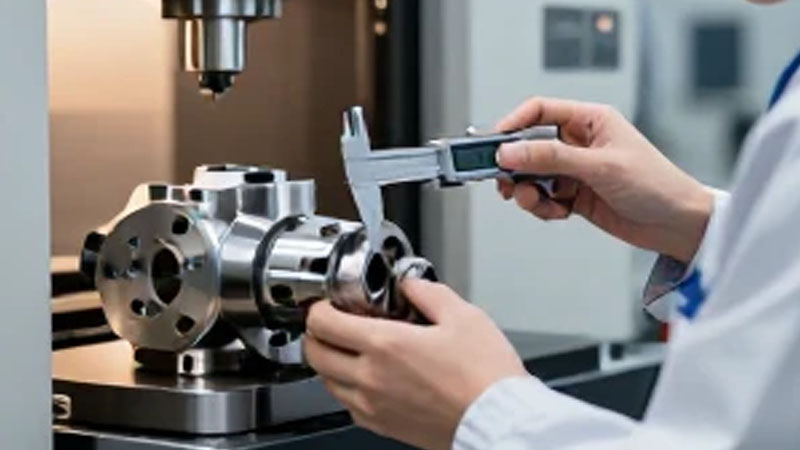
Industrial photography focuses on the places and objects where work actually happens: factories, warehouses, plants, construction sites, production lines, heavy equipment, and technical installations. It is not just about making those environments look polished. It is about showing how a business works, what it produces, and how it operates under real conditions.
That makes industrial photography a form of visual documentation as much as a marketing tool. A strong image may show a conveyor system in motion, a close-up of a machine component, a technician checking a control panel, or a wide view of a plant floor. In industrial contexts, accuracy matters. As one technical guide on industrial photography notes, sharpness, dynamic range, framing, and realism are all important because the image must preserve detail and communicate the scene clearly [1].
Industrial shoots also tend to happen in difficult environments. Lighting may be uneven, space may be limited, and the photographer may need to work around safety rules, moving machinery, or restricted access. That is why industrial photography usually requires more planning than a standard portrait session. The image has to be clear, informative, and trustworthy, not merely attractive.
A practical example is a manufacturing company that wants to show its production process to potential clients. A wide shot of the facility can communicate scale. A close-up of welds, textures, or finished parts can communicate quality. A sequence of images can then turn a complex operation into something a buyer can understand at a glance.
What Is Industrial Photography?
Industrial photography captures the operational reality of a business: factories, machinery, production lines, construction sites, and the processes that turn raw materials into finished products. It’s typically shot on location, in active and often uncontrolled environments — real lighting, real dust, real noise. The goal is authenticity and technical accuracy, showing a facility and its processes as they actually exist, often for use in technical documentation, safety records, investor materials, and B2B marketing that needs to demonstrate real operational capability.

How corporate photography presents people, trust, and brand identity
Corporate photography is centered on people and the professional identity of the organization. The most common examples are headshots, executive portraits, team photos, workplace scenes, and candid images that show collaboration or leadership. Its goal is not to document machinery or infrastructure, but to present the human side of a company in a consistent and credible way.
A well-executed corporate image helps a business make a stronger first impression. Adobe describes corporate headshots as a way to show off professional talent and create trust online. That is why these images appear on websites, LinkedIn profiles, press kits, investor pages, proposal decks, and internal communication materials. They work like a visual handshake before a real conversation happens.
Consistency is especially important in this category. If a company photographs ten employees, the portraits should feel like they belong together. The lighting, background, crop, and posture should align so the brand looks organized and intentional. That does not mean every image has to be identical. It means the set should feel like one visual system rather than a collection of unrelated portraits.
Corporate photography also has a softer operational challenge than industrial photography: it must make people comfortable. A photographer needs to direct expression, body language, and timing without making the subject look stiff. In practice, that often means a short session, simple direction, and a controlled environment that reduces distractions [2].
What Is Corporate Photography?
Corporate photography focuses on people and brand identity: executive headshots, team photos, boardroom shots, office culture images, and formal event coverage. It’s usually shot in a studio or a controlled office environment, with deliberate lighting and composition designed to project professionalism and polish. These images are built for LinkedIn profiles, annual reports, press materials, and “about us” pages — anywhere a business needs to put a trustworthy human face on its brand.
Industrial and Corporate Photography: the key differences
The first difference between Industrial Photography
The clearest difference between Industrial Photography and Corporate Photography is the subject. Industrial photography shows systems, spaces, machinery, and production; corporate photography shows people, roles, and organizational identity. That sounds simple, but it affects every creative decision that follows.
The second difference
The second difference is environment. Industrial shoots often happen on location in active work sites, where the photographer must adapt to noise, dust, limited access, and imperfect light. Technical evaluation of industrial photography places strong emphasis on lighting quality, exposure, focus, composition, and realism because the image may need to communicate exact detail rather than mood alone . Corporate shoots, by contrast, are usually staged in offices, studios, or other controlled spaces where consistency is easier to manage .
Advertising Photographer in Vancouver
The third difference
The third difference is audience. Industrial imagery often speaks to buyers, engineers, investors, regulators, or technical stakeholders who want evidence of capability. Corporate imagery usually speaks to clients, recruits, partners, and the public who want to understand who is behind the business. A factory image can prove that a company has operational depth, while a polished team portrait can make that same company feel approachable.
The fourth difference
The fourth difference is workflow. Industrial photography often needs more time for site access, safety coordination, and technical setup. Large equipment may require multiple angles, supplementary lighting, or detailed close-ups so that scale and function are visible [3]. Corporate sessions are often faster, but they demand strong interpersonal direction because expression and consistency matter across every portrait .
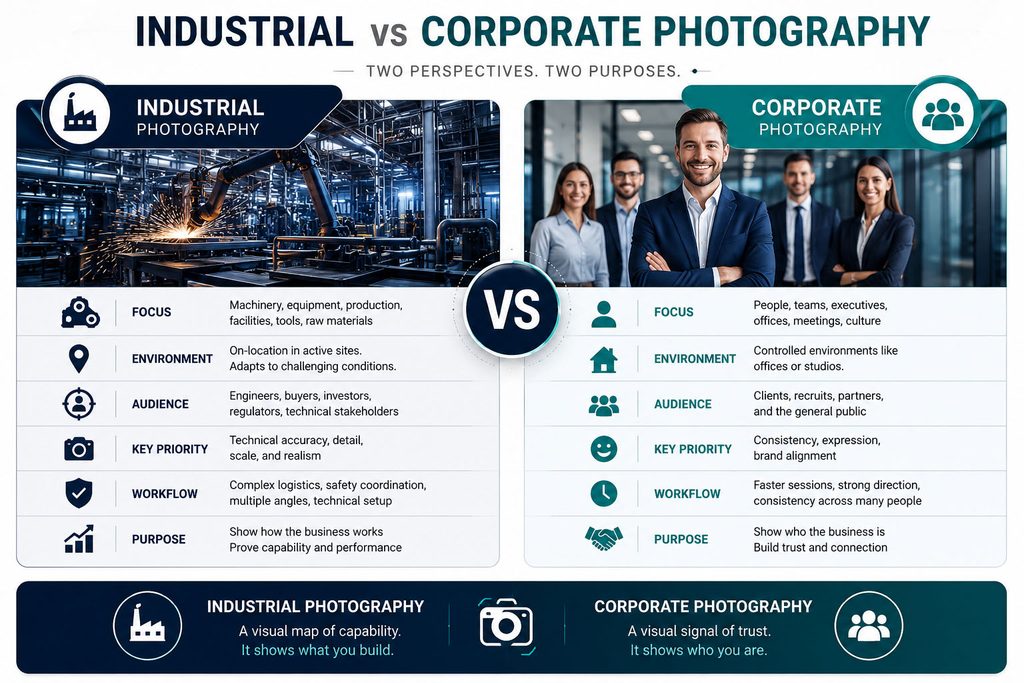
A useful way to think about it is this: industrial photography explains how the business works, while corporate photography explains who the business is. One is a visual map of capability. The other is a visual signal of trust.
Here is a practical comparison:
- Industrial photography often features machinery, production lines, tools, raw materials, and facilities.
- Corporate photography often features executives, staff, meetings, office environments, and branded portraits.
- Industrial images usually need stronger attention to technical detail and realism.
- Corporate images usually need stronger attention to consistency, expression, and brand fit.
- Industrial shoots can be more complex because of safety and location constraints.
- Corporate shoots can be more repetitive because they often need many people photographed in the same style.
In commercial practice, these styles are not competing categories so much as different answers to different business questions. If the question is, “Can this company build, make, or maintain something at scale?” industrial imagery is the better fit. If the question is, “Can I trust the people behind this company?” corporate imagery is usually the better fit.
Key Differences at a Glance
| Industrial Photography | Corporate Photography | |
| Primary Subject | Facilities, equipment, processes | People, teams, executives |
| Setting | On-location, working environments | Studio or controlled office settings |
| Lighting | Often natural/ambient, adapted to real conditions | Controlled, deliberate studio lighting |
| Purpose | Technical documentation, B2B credibility, safety records | Brand identity, recruiting, PR, executive presence |
| Typical Use | Investor decks, technical marketing, annual reports | LinkedIn, press kits, “about us” pages |
Which One Does Your Business Need?
When to Choose Industrial Photography
If you need to show what your company actually builds or produces — a manufacturing process, a construction project, equipment in operation — industrial photography is the right fit. It’s the natural choice for technical marketing, investor materials aimed at demonstrating operational capability, and any content meant to build credibility around what a company does on the ground.
When to Choose Corporate Photography
If the goal is putting a professional, trustworthy face on your business — leadership headshots, a team page, materials for a press release — corporate photography is the better fit. It’s built for situations where people, not processes, need to be the focus.
Why You Might Need Both
Most industrial and manufacturing businesses actually need both types of photography, just for different parts of their brand. A manufacturing company might use industrial photography to show its production floor and equipment in a pitch deck, while using corporate photography for its leadership team’s LinkedIn profiles and its annual report’s executive bios. Treating these as separate but complementary needs — rather than trying to stretch one type of shoot to cover both purposes — usually produces stronger results across the board, and often makes sense to plan and budget for together rather than as two unrelated projects.
Frequently Asked Questions
Yes, though it’s worth confirming a photographer has genuine experience in both — the skills involved (working in active industrial environments versus directing studio-style portraits) are different enough that not every photographer is equally strong at both.
No. Product photography typically shows a finished item in a controlled studio setting, isolated from its production environment. Industrial photography documents the facility and process behind that product, usually shot on location.
Pricing varies widely based on shoot length, location, number of deliverables, and usage rights, but corporate headshot sessions are generally priced per person or per hour, while industrial shoots are typically quoted per project based on site complexity and time required.
It depends on the business. A manufacturer may need industrial images to show capability, while a consultancy may need corporate portraits to create trust. Many companies benefit from a mix of both.
Because the images often appear across websites, team pages, and professional profiles. Adobe notes that consistency in color balance, backgrounds, and composition helps create a unified brand look
Yes, but not always. The two styles require different strengths. Industrial work demands technical problem-solving in difficult environments, while corporate work demands strong people skills and consistent portrait direction