The 80/20 rule, also known as the Pareto Principle, is a concept that has transcended its origins in economics to become a valuable framework across various disciplines—including photography. But what exactly is the 80/20 rule in photography? At its core, this principle suggests that roughly 80% of your results come from 20% of your efforts. This deceptively simple concept can revolutionize how you approach composition, gear selection, post-processing, and even professional development as a photographer.
Italian economist Vilfredo Pareto first observed this pattern in 1896 when he noted that approximately 80% of Italy’s land was owned by 20% of the population. Since then, the principle has been identified in countless areas: business, productivity, relationships, and—as we will explore—photography. The power of the 80/20 rule lies not in its mathematical precision, but in its ability to help us identify where our efforts will generate the greatest impact.
For photographers of all skill levels, understanding the 80/20 rule can lead to more intentional practice, better compositions, and a more rewarding creative journey. In this comprehensive guide, we will explore how this principle applies to various aspects of photography, from composition and equipment to skill development and professional practice.
The 80/20 Rule in Photographic Composition
When applied to composition, the 80/20 rule offers a powerful guideline for arranging elements within your frame. While traditional rules like the Rule of Thirds suggest dividing the frame into equal sections, the 80/20 approach embraces asymmetry and dynamic tension.
What Is the 80/20 Rule in Photography Composition?
The basic idea is simple: rather than centering your subject or dividing the frame equally, position the dominant element so that it occupies roughly 80% of the visual weight or area, while the remaining 20% provides context, contrast, or a secondary focal point. This creates what photographers call “dynamic tension”—an energetic quality that engages the viewer’s eye and makes the image feel more alive.
It is important to note that these proportions are not meant to be taken literally. The 80/20 rule serves as a “rough generalization” to encourage photographers to think about imbalance and visual weight rather than perfect symmetry. The actual proportions could be 90/10, 70/30, 60/40, or any variation that creates visual interest.
Why Asymmetry Matters in Visual Art
Photographs that are perfectly symmetrical and centered can appear “boring, static, and lack dynamic force and energy”. The human eye naturally finds more visual interest in images that present some degree of imbalance, as this creates tension and encourages the viewer’s gaze to explore the entire frame.
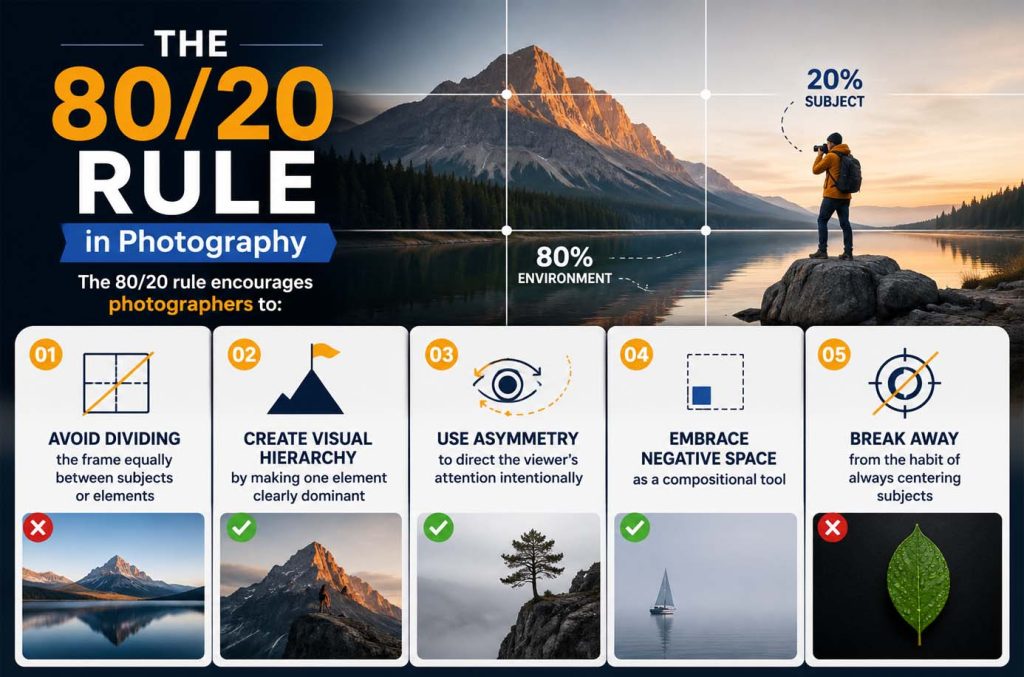
Consider this: our brain processes compositions where elements are placed in the “thirds” of the frame more naturally than perfectly centered subjects. This is why the Rule of Thirds has been such an enduring guideline in photography and visual arts. The 80/20 rule takes this concept further by suggesting that even more dramatic imbalances can create compelling images.
Practical Applications of 80/20 Composition
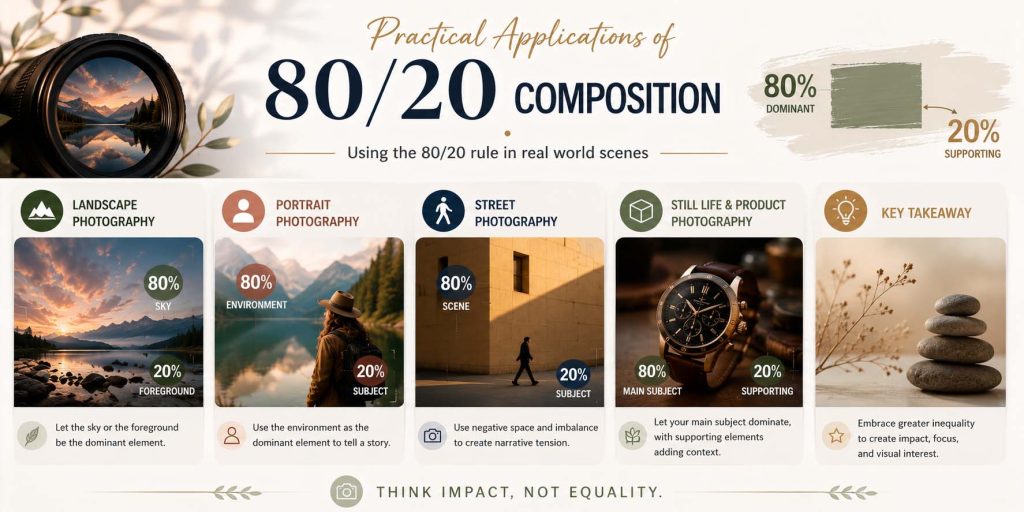
How can you apply this rule in the field? Here are practical examples of the 80/20 composition in action:
- Landscape Photography
When photographing a landscape, consider making the sky occupy approximately 80% of the frame if the dramatic clouds and light are the main attraction, with only 20% reserved for the foreground. Alternatively, if the foreground features an interesting subject like colorful wildflowers or unusual rock formations, let that occupy 80% of the composition with the sky serving as a 20% backdrop. - Portrait Photography
In environmental portraits, you might place your subject in approximately 20% of the frame, allowing the surrounding environment to fill the remaining 80% and tell a story about who they are or where they are.Best Settings for Portrait Photography - Street Photography
Urban scenes often benefit from the 80/20 approach. A single figure crossing a vast, empty plaza, or a solitary person passing through a busy street market—these compositions use the principle of imbalance to create narrative tension. - Still Life and Product Photography
Arrange your primary subject to occupy about 80% of the frame, with supporting elements filling the remaining space to provide context and visual balance.
The key distinction between the 80/20 rule and the more traditional Rule of Thirds is worth emphasizing: while both avoid perfect symmetry, the 80/20 rule suggests even more dramatic inequality between the dominant and supporting elements of the frame.
The 80/20 Principle in Gear and Equipment
One of the most practical applications of the 80/20 rule in photography concerns equipment. Many photographers fall into the trap of believing they need every lens, accessory, and gadget on the market to take good photographs. In reality, approximately 80% of your photographic results likely come from just 20% of your equipment.
Which Gear Actually Matters Most?
This realization can be both freeing and financially practical. Rather than accumulating an extensive collection of gear, the 80/20 rule encourages you to:
- Identify Your Core Setup: Determine which camera body, lenses, and accessories you actually use for the majority of your photography.
- Learn Your Equipment Thoroughly: Master the capabilities and limitations of your essential gear rather than spreading your learning across many different devices.
- Invest Strategically: When purchasing new equipment, prioritize investments that will have the greatest impact on the photography you actually do.
A Practical Self-Assessment
To apply the 80/20 rule to your gear, conduct this simple audit:
- Review the metadata from your last several months of photography
- Identify which lens was used for the majority of your best images
- Notice how often you use specialty accessories versus basics
- Consider selling or storing equipment that rarely gets used
This approach does not mean there is no place for specialized gear. A wildlife photographer may need a long telephoto lens, while a landscape photographer might prioritize a wide-angle lens and sturdy tripod. The 80/20 rule simply suggests that your most frequently used gear—the equipment that enables your vision—deserves most of your attention and budget.
Applying the 80/20 Rule to Skill Development
The 80/20 rule is particularly valuable when applied to skill development. Photography encompasses an enormous range of technical knowledge and artistic sensibilities. The sheer volume of skills can feel paralyzing—especially for beginners.
Learning the Vital 20% of Photography Skills
However, research suggests that a small fraction of what you learn accounts for most of the improvement in your photography. The key is identifying which skills produce the greatest impact and focusing your learning efforts there.
For the 80/20 rule in photography education, the high-impact skills are often not the most technically complex:
- Composition Fundamentals
Understanding how to arrange elements within your frame—through the Rule of Thirds, leading lines, the 80/20 rule itself, and other compositional guidelines—delivers enormous returns on learning investment. This is why many photography instructors emphasize composition first, as it can dramatically improve images without requiring any technical knowledge about cameras. - Lighting Principles
Learning to see and work with light—whether natural light, available light, or artificial lighting—is another high-return skill. Understanding basic concepts like the direction of light, quality of light (hard vs. soft), and color temperature can transform your photography. - Technical Basics
Mastering the exposure triangle (aperture, shutter speed, and ISO) allows you to consistently achieve the technical results you envision. These three settings, while not all-encompassing, form the foundation of photographic control. - Post-Processing Essentials
In editing, a handful of techniques—like adjusting exposure, contrast, and white balance; cropping; and basic retouching—will improve the vast majority of your images.
The Gesture and Value Approach
For photographers and visual artists interested in understanding the 80/20 principle in art learning, there are parallels to drawing instruction. In the visual arts, focusing on gesture and flow, basic shapes and construction, and value relationships (light and dark) provides the most significant improvement .
A photograph with strong composition and clear contrast between light and dark areas will look more professional than one with technically perfect exposure but weak visual structure. This is why seasoned photographers often emphasize that “learning composition is the 80%” while other, more technical aspects might only represent the remaining 20%.
The 80/20 Rule in Post-Processing and Editing
Efficiency in the Digital Darkroom
Post-processing is another area where the 80/20 rule applies powerfully. Many photographers spend excessive time editing every image in a collection, when in reality, a small percentage of their photographs will receive most of the attention and use.
This manifests in several ways:
- Approximately 20% of the images from a shoot will likely produce 80% of the final selects
- A few core editing techniques account for most of the improvement in your images
- A small portion of your editing time may be spent on images that actually matter
Strategic Editing Workflow
An 80/20-informed editing workflow might look like this:
Culling
The first step is to efficiently select the best images from a shoot. Rather than attempting to edit every photograph, identify the 20% that are worth working on and invest your editing time there.
Core Adjustments
Focus on the adjustments that provide the most improvement: exposure correction, color balance, contrast enhancement, and cropping. These fundamental edits have the greatest impact on image quality.
Batch Processing
Apply basic adjustments to groups of similar images to save time, then do individual fine-tuning only on the most important photographs.
Know When to Stop
Perfectionism can lead to diminishing returns. Once an image is 80% of the way to your vision, it may be time to move on to the next photograph rather than spending hours chasing minor refinements.
The 80/20 Rule for Managing Your Photographic Output
Culling and Selecting Your Best Work
One of the most straightforward applications of the 80/20 rule in photography relates to selecting and curating your images. The principle suggests that roughly 20% of the photographs you take will account for 80% of the impact of your portfolio.
Many experienced photographers have intuitively discovered this: they shoot hundreds of images and keep only a small fraction. This is not a sign of failure—it is a recognition that not every image needs to be a masterpiece. As photographers often advise, “By taking tons of photos, the odds are in my favor” .
A common piece of advice for photographers is to “take lots and lots of pictures” knowing that digital photography has made it cheap to do so, and you can simply delete the ones that don’t work. This approach acknowledges that the 80/20 rule often skews even more dramatically: you might keep only 10-15% of the images from an event, and those will be the “gems”.
Business Photographer Vancouver
Building a Strong Portfolio
For photographers working on their portfolios, the 80/20 rule offers a helpful filter:
- Be Selective: A portfolio with 20 excellent images is more powerful than one with 100 average images
- Seek Feedback: Ask viewers which images resonate with them; often, a small number will be identified as standouts
- Curate Ruthlessly: Regularly review your portfolio and remove images that no longer represent your best work
- Embrace the “Unseen”: Recognize that the 80% of images that don’t make the final cut are still valuable—they provide practice, experimentation, and context for understanding what works
Professional Applications of the 80/20 Rule in Photography
Client Relationships and Revenue
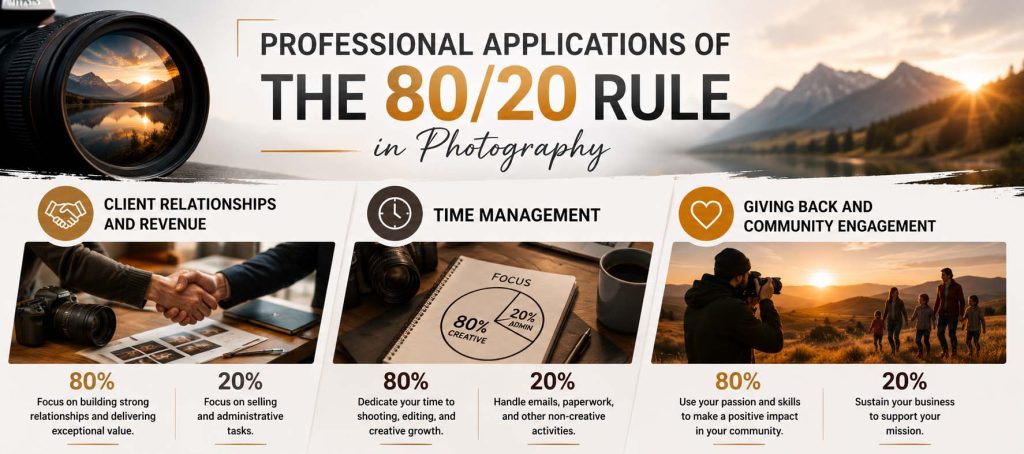
For professional photographers, the 80/20 rule often appears in business metrics. A classic business application is that roughly 80% of revenue comes from 20% of clients. Understanding this can help photographers focus their energy on nurturing relationships with their most valuable clients while maintaining efficient service for others.
Time Management
The 80/20 rule also applies to time management. Professional photographers might find that 20% of their activities generate 80% of their business success. These high-value activities might include:
- In-person client meetings and consultations
- Portfolio development and marketing
- Building relationships with potential clients
- Creating content that demonstrates expertise
Giving Back and Community Engagement
The 80/20 principle can also be applied to professional development and community involvement. Some photographers suggest that spending 20% of their time on community-focused activities—such as teaching, participating in photography groups, or mentoring—can enrich the remaining 80% of their professional work.
As one photographer described it, “I work hard to do in my photographic life is to live by what I call the 80/20 Principle. What I mean by this, simply put, is that I strive to spend 20% of my photographic time on non-revenue producing activities”. This approach often leads to renewed inspiration, stronger community connections, and even unexpected professional opportunities.
For photography enthusiasts, participating in photography clubs, attending workshops, and volunteering skills for community projects can provide similar benefits without requiring a professional focus.
Common Misconceptions About the 80/20 Rule
- The Rule Is Not a Mathematical Law
- A crucial point to understand is that the 80/20 rule is not mathematically precise. The proportions may vary—it could be 90/10, 70/30, or any ratio where a small percentage of inputs produces a majority of outputs. The value of the rule lies in its principle of identifying disparities and focusing energy where it will have the greatest effect.
- The Rule Encourages, Not Discourages, Improvement
- Some might misinterpret the 80/20 rule as an excuse for mediocrity—that 80% of your photos will be “good enough” and you only need to work on 20%. This is a misunderstanding. The rule actually encourages improvement by helping you identify which aspects of your photography to focus on for the greatest results.
- The Rule Is a Guide, not a Prescription
- The 80/20 rule should be seen as a guide to help you think more strategically about your photography, not a set of strict proportions to follow in every composition. As one photographer noted, “the 80/20 rule shouldn’t be taken literally” . The value comes from the mindset shift, not the precise percentage.
Industrial Photographer North Vancouver
Conclusion
The 80/20 rule in photography is far more than a simple compositional guideline—it is a philosophy of creative efficiency and intentional practice. Understanding the 80/20 rule in photography empowers you to work smarter, not harder, in every aspect of your photographic journey.
At its simplest level, the rule encourages you to create dynamic, engaging compositions by embracing asymmetry and visual tension. More broadly, it invites you to consider where your efforts yield the greatest returns: perhaps it is in mastering a single lens rather than collecting many, in prioritizing composition over technical perfection, or in curating a small number of exceptional images rather than a large collection of mediocre ones.
For photographers at any level, the 80/20 rule offers a valuable lens through which to view their practice—helping identify what truly matters and letting go of everything else. By embracing this principle, you can focus on the 20% that will make 80% of the difference in your photography. Whether you are a beginner seeking to improve your composition or a professional wanting to streamline your workflow, the 80/20 rule provides a framework for more intentional, effective, and ultimately more satisfying photography.
Mandana Rostami (Photographer north vancouver)
Frequently Asked Questions About the 80/20 Rule in Photography
What exactly is the 80/20 rule in photography?
The 80/20 rule in photography is the application of the Pareto Principle—the idea that approximately 80% of your results come from 20% of your efforts. In photographic composition, it specifically suggests creating dynamic, asymmetrical images by making one element dominate approximately 80% of the frame while the remaining 20% serves as context or a secondary focal point.
How does the 80/20 rule differ from the Rule of Thirds?
While both guidelines help photographers compose more interesting images, they take different approaches. The Rule of Thirds divides the frame into a three-by-three grid and suggests placing key elements along the grid lines or intersections. The 80/20 rule emphasizes a more dramatic imbalance, suggesting roughly an 80/20 split between dominant and supporting elements.
Does the 80/20 rule mean 80% of my photos should be bad?
No. The rule is not a quality standard but a recognition that in any creative process, a minority of your images will have the majority of the impact. This is a normal and healthy part of photographic practice, not a sign of failure.
Is the 80/20 rule only for composition?
No. The 80/20 rule applies to many aspects of photography, including selecting and using equipment, learning photography skills, editing workflow, building a portfolio, managing professional clients, and developing photographic projects .